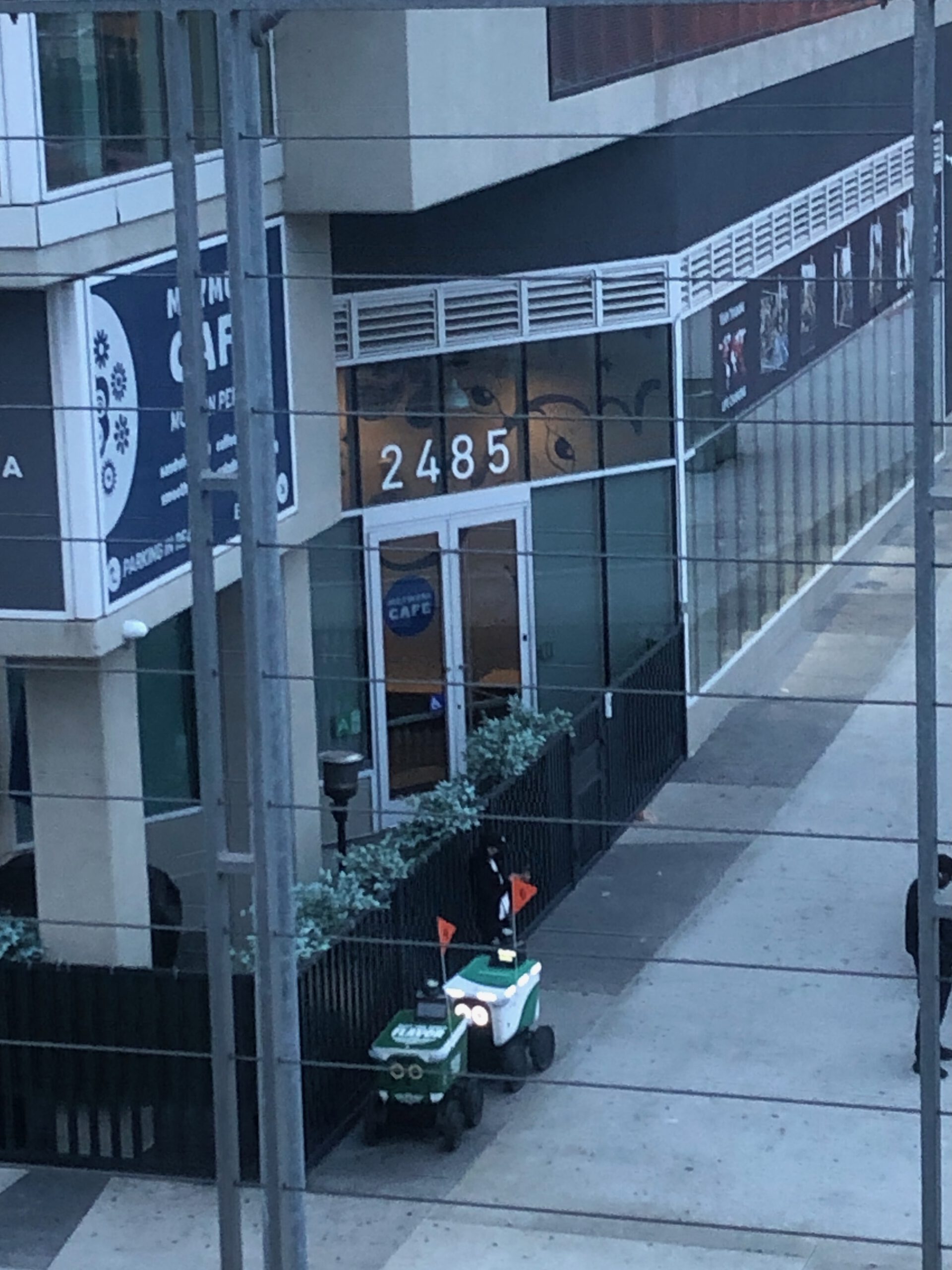
“I can’t really hate the robots,” I say to my husband, about a half-mile or so into a walk up Sawtelle. We’ve passed a smattering of delivery bots already. The one in front of me is a green, doe-eyed model named Noor. “When I see them, I think of Wall-E.”
Almost immediately, déjà vu hit. Did we have this conversation before somewhere closer to home? Maybe near 7th Street, where downtown’s IRL bot armies tend to congregate? “I know I’m being emotionally manipulated,” I add. I’m anthropomorphizing the tech that’s contributing humanity’s demise. Or, something like that. I can’t bring myself to hate the robots, but they are definitely harbingers of doom.
I remember seeing Wall-E back when it was released and leaving the theater with an incredibly heavy feeling, a sort of existential dread that comes with the realization that a Pixar movie was revealing some truths about our future that no one really wanted to discuss in 2008. Even today, nearly 20 years later, there’s a reluctance to address this collision of unchecked corporate power, unnecessary tech, over-consumption and isolation that’s leading us into increasingly dark times.
Steps away from Noor, we pass another robot, this one with the Wings Stop logo emblazoned on its screen. I don’t know what irritates me more, I say, is it that people are too lazy to go outside and pick up to-go or is it that they live in a neighborhood full of good restaurants and order Wings Stop?
I know. I know. I know. Why can’t I just “let people enjoy things” and shut the fuck up? It’s because letting people “enjoy things,” and I’m certain I’ve said this somewhere before, is why our dystopian society just keeps getting worse. There are some really good reasons to use delivery services. If you’re sick or don’t have a grocery store in your neighborhood, they come in handy. But, app companies aren’t going to make money on those circumstances alone. Like every other Industry Disruptor, they need all of us to believe that these things are indispensable, when they aren’t. Consequently, we get Influencers living out photogenic-yet-insipid lives while hyping the tech. Then legacy media, still trying to hang on to its last shred of relevance, launches the onslaught of uncritical trend pieces. Quickly, the rest of us adopt the new tech without thinking about its costs- to our budgets, privacy, peace of mind, etc.- lest we be viewed as old farts.
But, even after that happens, the new tech elite remain unsatisfied, so, they’ll squeeze fees out of small businesses that had to adapt or die of irrelevance. They’ll spend oodles on political campaigns so that they can keep wages low and ensure that both labor and consumer rights are virtually non-existent. Now that they’ve succumbed to insatiable greed, they’ll bring in the bots and artificial intelligence, whatever they can to cut out any human who might need to get paid. This is going to change the world, they’ll tell you. You need to get behind this or you’ll be left behind! And we just go along with it, when we know – because we’ve seen this pattern repeatedly – that we’re screwing ourselves over in the process.
At some point that afternoon, I saw Noor again, sleeping on the job in front of one of those apartment buildings named after London neighborhoods. Throughout this one trip to the Westside, I’ve seen far more delivery bots than I typically encounter downtown. They’re crossing streets and meeting up with each other at corners. In some spots, it’s a livelier scene than the human one.
If you’ve never seen Wall-E, it’s about the last robot left to clean up an Earth that humans trashed before splitting for space. An average viewer would see the movie as a dystopian children’s story with a moral or two embedded in it. And, as is typical of science fiction cautionary tales, those messages went clear over the heads of the tech bros. Now we’re living in cities where growing populations of robots with sad Wall-E eyes are delivering coffee and chicken wings, thus freeing up our time to do more productive things, like arguing with bots and sharing AI-generated content, while we trash the planet and the billionaires plot their escape to space.
We’ve let the tech hype machine convince us that having daily “little treats” delivered to apartment buildings designed for shut-in life is totally normal and acceptable. It is not. It is why living in the future sucks. The idea of a “frictionless life,” where tech does the stuff that would normally force you to interact with the world outside your phone, is a popular topic of conversation online, but I don’t really like to think of tech as removing friction. Instead, it’s weakening connections that can’t be replicated through screens. We do need to get outside and use our own senses to observe our communities. We do need to interact with each other IRL.
An irony of modern life is that the more tightly tied we are to our devices, the more untethered we become from each other. And, as that distance between us grows, the more disconnected we become from reality. We’re already in a place where people believe the interpretation of events on their phone more than what they could have witnessed with their own eyes and ears and, so far, that doesn’t seem to be working out too well for us.
If cel phones could prompt us to forget phone numbers and GPS made learning directions irrelevant, what will happen as we offload our random human interactions to the robots? Do we just fall deeper into our personalized feeds? Does our empathy atrophy? Do we slowly lose all the attributes that make us human? Those are the questions I wish people would consider when we’re talking about new tech because that’s what I think about now whenever I see the delivery bots out on the town.
Liz O. is an L.A.-based writer and DJ. Follow on Instagram or sign up for the weekly, Beatique newsletter for updates on new stories and gigs.
Listen to Beatique, April 2026 on Mixcloud, featuring music from Slayyyter, Kneecap, Yeah Yeah Yeahs, Armand Van Helden and more.
Keep Reading:
ADULT. Captures Real World Dystopian Tension on Kissing Luck Goodbye