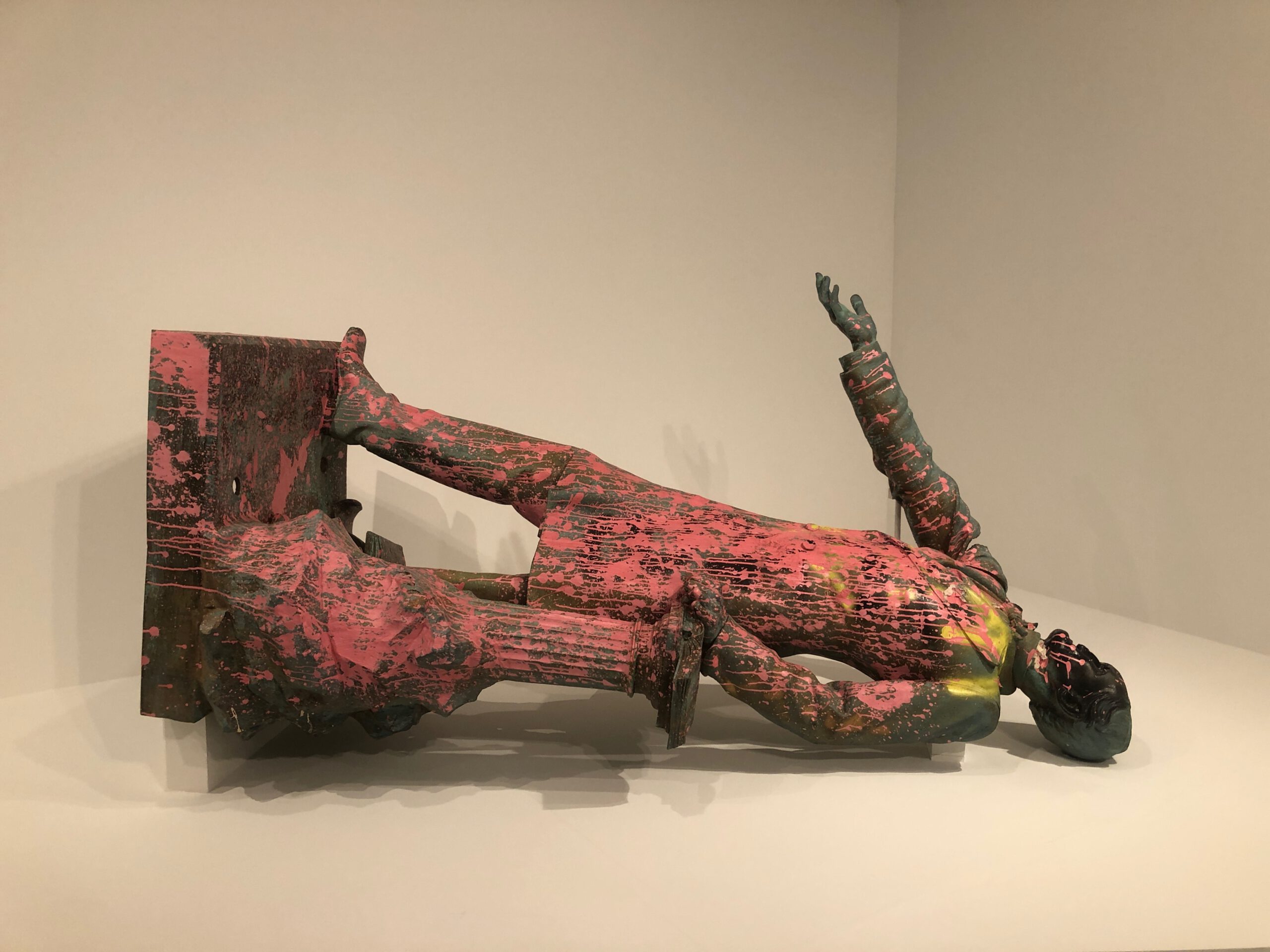
Jefferson Davis looks like he’s been clocked. The oversized, bronze statue of the onetime president of the Confederacy is laid out on the floor of the Geffen Contemporary at MOCA. He’s splotched and tagged with paint, dried pink streams running down the length of the statue like blood. Walk up close and you’ll see that the top of his head has been pounded flat. An outstretched arm, partially severed from the shoulder, may have once given him the appearance of a savior. Now, it looks like he the one who needs saving. I study the hulking figure for a few moments, snap a couple photos and continue through the museum. Some monuments are better left down for the count.
Monuments, a collaboration between MOCA and The Brick that’s on view at the Geffen Contemporary through May 3, is an exhibition juxtaposing decommissioned monuments with contemporary art to explore U.S. post-Civil War history. The Jefferson Davis statue, which was dedicated in 1907, lived in Richmond, Virginia, where it was part of a whole complex of Confederate monuments. In 2018, a local commission in Richmond recommended its removal, but that didn’t happen until two years later, when the statue was paintbombed and toppled during protests following the murder of George Floyd.
Not far from the felled Confederate is Homegoing from filmmaker Julie Dash and singer Davóne Tines. The video is a tribute to those killed in the 2015 mass shooting at Emanuel African Methodist Episcopal Church in Charleston, South Carolina. Footage of the church, as well as that of an ancient live oak grace the screen as Tines, an opera singer with a bass-baritone voice, sings a variation of “This Little Light of Mine” called “Let It Shine.” It sounds as if he is singing inside an old, vacant church, and, if you listen closely, you can hear what might be field recordings of nature layered underneath.
Seeing these two drastically different memorials next to each other, it’s not difficult to draw the conclusion that the lionization of slavery-defenders many years after they lost the Civil War correlates to egregious acts of violence against Black Americans today. We’ve never quite managed to reckon with the racism at the core of U.S. history and, as a result, every hard-won step towards a just society is followed by a backwards slide downhill.
Walking through the exhibition, I’m struck by how grandiose some of the decommissioned monuments are. I step close enough to one depicting Robert E. Lee and Stonewall Jackson on horseback to notice that I’m about as tall as one horse leg on its stony podium. It’s intimidating and that’s probably the point. Other statues here make use of angels and messianic poses, connecting the South’s “Lost Cause” mythology to Christianity.
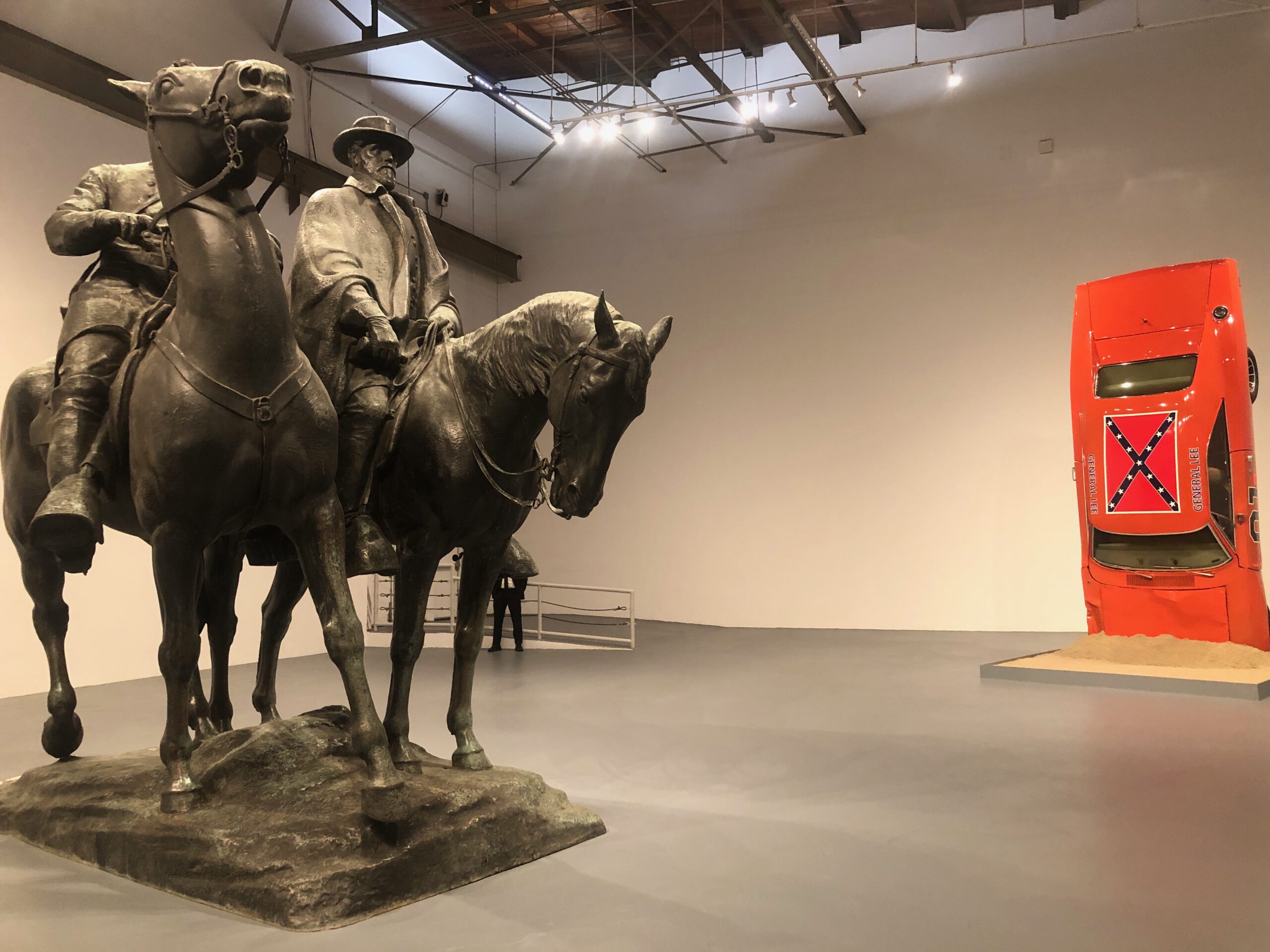
Contrasting the decommissioned monuments are thought-provoking new artworks, like A Suspension of Hostilities by Hank Willis Thomas. A recreation of the General Lee from The Dukes of Hazard posed as if it’s taking a nosedive into quicksand, the piece comments on how ingrained Confederate imagery is within American pop culture. Jon Henry’s Stranger Fruit series of photographs focuses on mothers with their sons in a response to the police killings of Michael Brown and Tamir Rice. The title of the series references “Strange Fruit,” the protest song against lynchings made famous by Billie Holiday.
One of the first pieces I saw in what is a fairly large exhibition, the busted Jefferson Davis statue is also the one that has stuck in my head in the days following my visit. That the statue existed in the first place says so much revisionist history and nostalgia for times that never existed. Did you know that there are more statues of him in the U.S. than there are of Harriet Tubman? Monument Lab created a digital artwork based on their 2021 study that reveals all sorts of information about who Americans choose to memorialize. I should say that the results are shocking, but, really, they aren’t.
People always say that “history is written by the winners,” but that’s not exactly true. Some losers spend a lot of time and energy trying to reframe and reexamine their cause. We saw that firsthand with the MAGA comeback of 2024. We know how easy it is for people to succumb to propaganda and then ask for seconds of a shit sandwich. The now-decommissioned monuments, erected decades after the Civil War by groups like Daughters of the Confederacy, are a very slow, analog version of the same thing. They function with the intent of portraying Confederates as noble warriors for causes like state’s rights and heritage, which is about as laughable as depicting Donald Trump as a champion of free speech and peace.
But, while walking through Monuments, you can also see how U.S. myths are being dismantled. Towards the end of the exhibit, there’s a fragment of a Robert E. Lee monument that has been tagged with the phrase, “As white supremacy crumbles.” In the outside world, there more signs that people have had enough of lies and propaganda, of celebrating powerful men who did terrible things. We see it in street art and memes, on the news and in our daily conversations. What Monuments does really well is show how these relics of an imagined past need to be toppled so that society can movie forward.
Liz O. is an L.A.-based writer and DJ. Follow on Instagram or sign up for the weekly, Beatique newsletter for updates on new stories and gigs.
Listen to Beatique, March 2026 featuring music from Grrrl Gang, Peaches, Charli xcx, The Smiths and more.
Keep Reading:
Depeche Mode, Fontaines D.C. and War Child: The Wars Change, But the Protest Songs Remain the Same