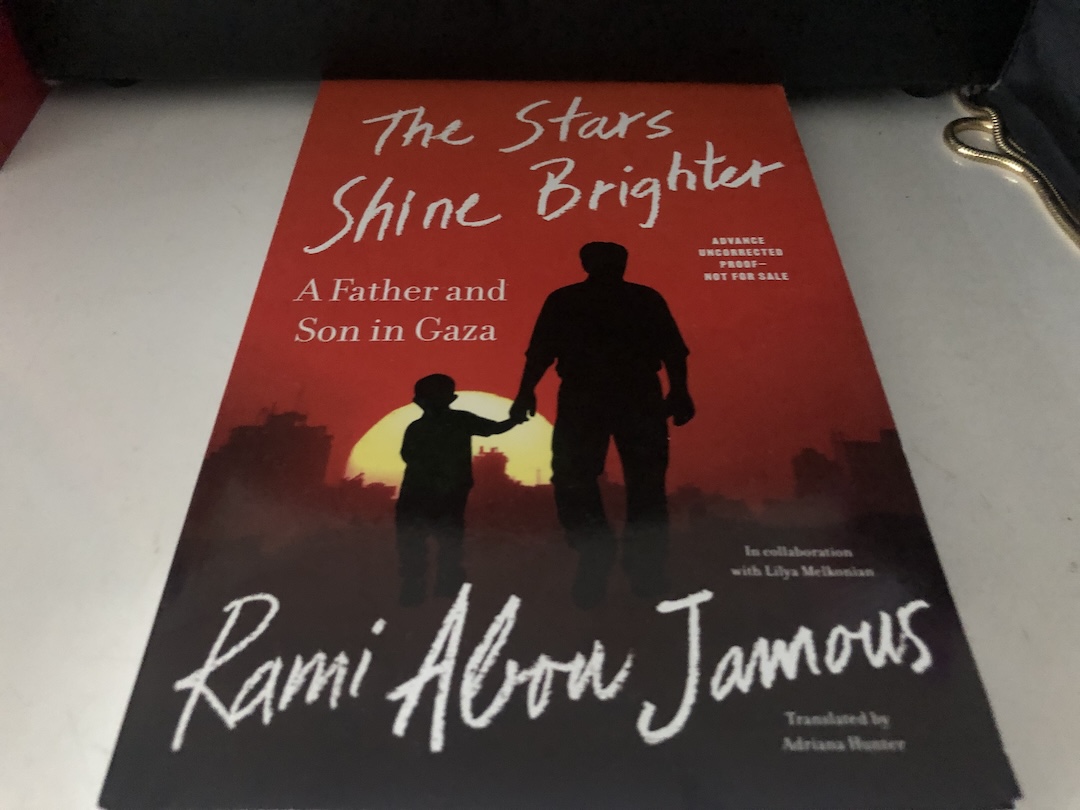
If there’s one new book you read this year, it should be The Stars Shine Brighter by Rami Abou Jamous. Released last month, it is the Palestinian journalist’s first-person account of life in Gaza during the first two years of the genocide. It’s a short, concise read that is, frequently, devastating. For those of us reading in the U.S., it’s also the rare glimpse inside Gaza that’s uninterrupted by the noise of political spin, propaganda bots, racist assholes and everything else that makes so many people shy away from even mentioning Palestine.
Jamous is an award-winning war correspondent who has reported from Gaza for multiple French outlets over the past few years. (You can read his more recent columns in Orient XXI) In The Stars Shine Brighter, he documents both what is happening in the communities surrounding him and how he tries to keep his own family safe.
With a reporter’s attention to factual details and a diarist’s intimacy, Jamous describes events that have made it into some news reports, like the Al-Shifa Hospital siege and the airstrike on the Church of Saint Porphyrius. He is not merely an observer of what is happening, as Gaza is his home. Jamous knew people who died in both the hospital siege and the church airstrike. Here, as well as in recounting other atrocities throughout the book, he is able to memorialize some of those who are amongst the now 74,000+ dead in Gaza. He gives us their names and adds personal details that we might not see in news reports.
Jamous also recounts his own harrowing experiences. On one life-changing day, he hears an explosion near his home and races inside the building to find his wife and young son. They are okay, but a new journey begins. First, they band together with neighbors to take care of each other, Eventually, though, his family must escape Gaza City. All the while, food and supplies grow scarce and danger is ever-present.
Throughout the book, three themes emerge. One is that, for the Palestinians of Gaza, there is nowhere to go. You can leave one city for another, but the bombs eventually follow. You’re neither safe at home, nor on the street. Hospitals and religious sites are not exempt from destruction. For many people, and for many reasons, leaving Gaza isn’t an option. People are stuck in an impossible situation.
The subtitle of The Stars Shine Brighter is “a father and son in Gaza,” which highlights the position Jamous is in as the parent of a very young child at the onset of the genocide. In late 2023, Walid, Jamous’ son, is too young to understand what’s happening. But, time passes, the violence continues and Walid grows more aware of his surroundings. So, Jamous is not only concerned with protecting his son’s physical well-being, but also his childhood innocence.
That leads directly to the third, and most prominent, theme, which is human dignity. From the many details that Jamous offers it’s clear that Israel’s goal isn’t just to annihilate Gazans, but to try to humiliate them in the process. Jamous says as much in The Stars Shine Brighter and it’s evident in practices like the blockade of humanitarian aid, destroying the healthcare system and sniping people as they try to tend to the dead, all of which is documented in this book and in outside news reports. With every scene he describes, Jamous reveals another layer of cruelty in Israel’s campaign against Palestine.
Because of my own family history, I’ve read a good amount of Armenian Genocide memoirs. There are a lot of those- really, it’s a genre of Armenian diasporan literature- and they serve a specific function as witness testimony for a genocide that has been repeatedly denied by Turkey. The Stars Shine Brighter fills a similar role for the Gaza Genocide, which Israel continues to deny. The difference is that Jamous documented a genocide that’s happening right now, one that, in theory, we have the power to stop. That’s particularly true for a U.S. audience, given that our taxes help fund this nightmare scenario that plays out with weapons our country provides. We have to speak out, even if it feels like no one is listening.
That leads to another reason why The Stars Shine Brighter is a crucial book to read right now. It is a tangible testimony that can’t get shadowbanned. You won’t be greeted by a mysterious 404 message when you finally get around to clicking the link to read it. It’s a real, physical book that you can keep on your nightstand to read whenever you’re ready and reference whenever needed.
The Stars Shine Brighter by Rami Abou Jamous is out now.
Liz O. is an L.A.-based writer and DJ. Follow on Instagram or sign up for the weekly, Beatique newsletter for updates on new stories and gigs.
Listen to the Beatique Mix for October, 2026, featuring music from Hercules & Love Affair, The Strokes, ADULT., Tinashe, Gorillaz and more.
More:
Depeche Mode, Fontaines D.C. and War Child: The Wars Change, But the Protest Songs Remain the Same
Best of 2025: The Year in Political Songs
David J Sings of History Repeating in New Protest Single, “ICE Too Cold to Thaw”