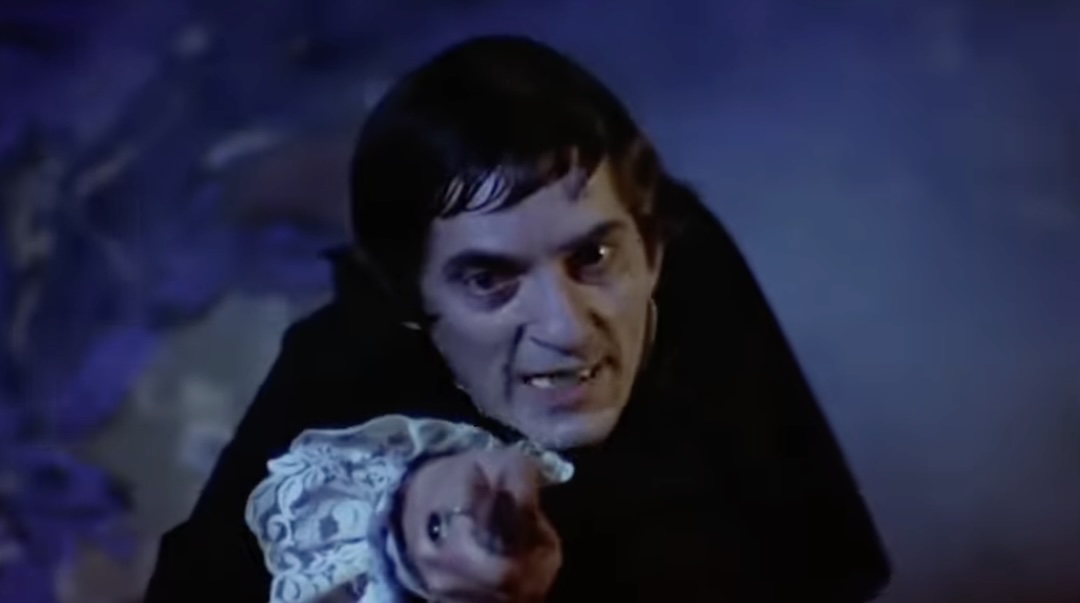
In 1970, just a few short years after Barnabas Collins took Dark Shadows from struggling soap opera to pop culture phenomenon, the vampire’s journey began anew. This time, though, it played out on the big screen. House of Dark Shadows was the first of two films based on show and made by the team behind the television series. Unlike the much more recognizable 2012 film, this one is actually worth watching. At the time of writing this, House of Dark Shadows is streaming on YouTube. If you want to see it in a theater, and live in Los Angeles, it’s screening at the NoHo 7 on Monday, July 27.
House of Dark Shadows is an alternate version of the soap opera’s best known storyline. The show began life as a gothic saga centered around the very wealthy Collins family of fictional fishing town Collinsport, Maine. Early on, the drama bore an eerie similarity to books like Jane Eyre and The Count of Monte Cristo, literature that served as the precursor for the 20th century soap. There were also some supernatural elements early on, like a legitimately scary plot where it’s revealed that Roger Collins’ ex-wife is a phoenix. The show didn’t become a hit, though, until the mysterious Barnabas Collins knocks on the door of Collinwood. Barnabas is a vampire who had been languishing in the family mausoleum for over 100 years, but he passes himself off as his own descendent who recently arrived from England. Long story short, he falls in love with waitress Maggie Evans, who looks like his long-dead finance Josette, and kidnaps her. Dr. Julia Hoffman is tasked with treating Maggie, but becomes intrigued by Barnabas and attempts to cure him of his vampirism.
But, all of that happened in 1967, three years before the movie hit theaters. In that time, Dark Shadows had taken the daytime TV audience back to 1795 to meet the witch who cursed Barnabas with eternal life. Back in the present day, Angelique, the witch (and best evil blonde daytime television has ever seen), arrives with another curse for the Collins family. Then a Turn of the Screw haunting prompts Barnabas to use the I Ching to go back to 1897, solving both the mystery of the ghost and a werewolf curse, which turns into a Picture of Dorian Gray curse with shades of Pygmalion that leads to a doomed Orpheus and Eurydice love story. Meanwhile, the town deals with a Frankenstein’s monster and would-be bride, a werewolf and even a Rosemary’s Baby who grows up really fast. At the time of the film’s release, the TV show was in the midst of a Rebecca-meets-Dr. Jekyll and Mr. Hyde arc that took place in a parallel version of 1970.
This is just a really long way of telling you that, between the original Barnabas Collins storyline and House of Dark Shadows, so much happened on the show that it probably didn’t matter whether or not the film followed the storyline. There’s no way it could, so don’t watch this expecting an hour-and-a-half summary of an arc that initially ran five days a week for (roughly) six months. In fact, you don’t need any kind of Dark Shadows background to enjoy the movie. It does, however, help, if you’re into 1960s/1970s horror films.
The basic premise is pretty close to what happens in the series. Barnabas is released from his tomb and introduces himself to the Collins family as a long-lost cousin, which they take at face value because he’s the spitting-image of the Barnabas Collins portrait hanging in their museum-caliber entryway/art gallery. Barnabas sees Maggie, a governess rather than a waitress in the film, and pines for her based the woman’s resemblance to the late Josette. Dr. Hoffman figures out that Barnabas is a vampire and tries to cure him, but, well, I won’t spoil that part.
For a theatrical release, the Dark Shadows team could push the envelope in ways that they couldn’t on daytime television. Still, they don’t push it that far, even by 1970s standards. There’s definitely more gore, but it’s still fairly tame. While House of Dark Shadows is nowhere near as horny as a Jean Rollin film, or even some of the Hammer Horror entries of this era, sex is implied a bit more than in the television show. (Dark Shadows is actually pretty chaste for a soap, but, then again, most of my knowledge of the genre is from the 1980s onward.)
What Dark Shadows has in common with European horror of the era is a super moth (that’s mod + goth for those of you unfamiliar with Y2K L.A. subcultures) atmosphere with Barnabas as the Keith Moon of vampires, running amok in a manor where opulence and decadence collide. The costumes are fantastic. It made me long for the days when you could actually find something like Carolyn Stoddard’s glittering Romeo & Juliet gown or Maggie’s lime green minidress in a thrift store.
There are some fantastic scenes in House of Dark Shadows. One of my favorites is when vampire Carolyn terrifies creepy kid David Collins in a what looks like a drained and dilapidated indoor pool. It’s simultaneously ethereal and sinister. And the movie’s climax- filled with terror and cobwebs and candles- is exactly what I like in a horror film.
The pacing of the film is fast- the writers did pack a lot into a fairly short amount of time- so it’s best to watch when you have time to focus on just one screen. While there’s not nearly the amount of character development that you’ll see in the series, there’s enough to figure out who’s who pretty quickly. Overall,House of Dark Shadows worth watching at least once, whether you’ve already seen Dark Shadows, or you want to get an idea of what it’s all about before committing to a series with 1200+ episodes.
Liz O. is an L.A.-based writer and DJ. Follow on Instagram or sign up for the weekly, Beatique newsletter for updates on new stories and gigs.
Listen to the Beatique Mix for July, 2026, featuring music from Madonna, Tomora, Basement Jaxx, Saint Etienne and more.
Read more:
Lost in Time Watching Dark Shadows
Director Christopher Bickel on Pater Noster and the Mission of Light
Goodbye Horses: The Many Lives of Q Lazzarus Is More Than a Music Documentary