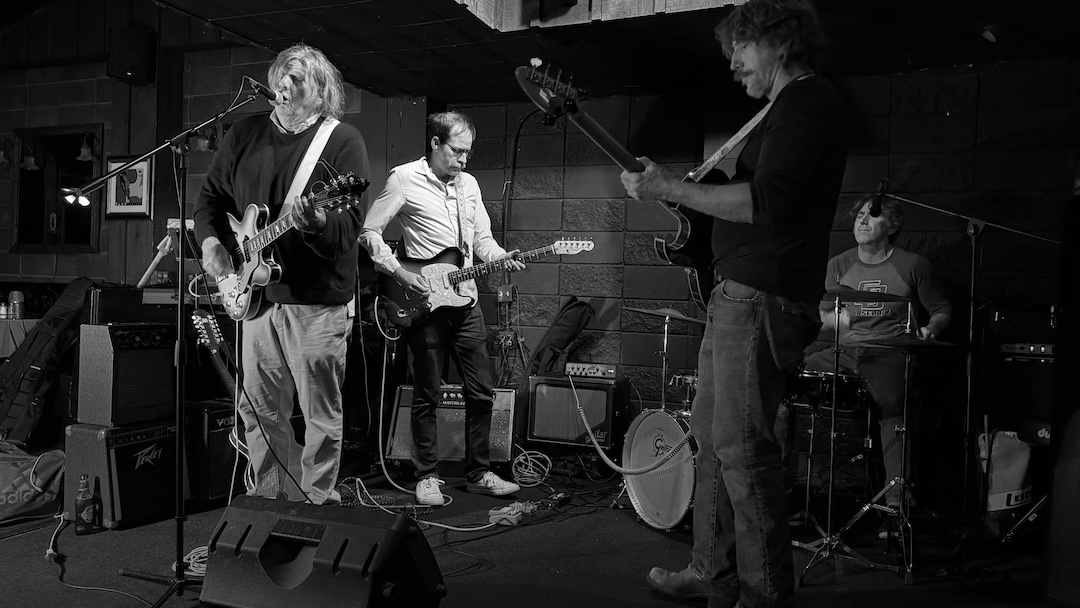
For Drew Miller, one word sums up the themes that attract Boiled in Lead to traditional tunes: Darkness.
Darkness extends to the Celtic punk band’s name too. Boiled in Lead is derived from an Irish song, “The Two Sisters,” specifically a version associated with Clannad and is a reference to the punishment that befell a murderous sibling. “In 1983, that seemed like a really good name for a punk rock band doing folk music,” the bassist explains.
Grrrl Gang spends a lot of time online. “It’s just too much sometimes, to be honest,” says bassist Akbar Rumandung. But, the inspiration for the band’s latest release, Online 24/7, hit IRL via a photoshoot at a friend’s gallery. One shot of the Indonesian punk band, taken through a window with a sticker that read, “Online 24/7” on it, stood out. It looked as though people were watching the band through their phones.
“That photo it reflects what we actually feel as a band nowadays,” says Rumandung on a recent video call from Jakarta, “where people try to categorize us through social media through what they see about us through social media, where they don’t actually know us, they don’t actually understand what this band is actually about.” It also, coincidentally, fit the music that Rumandung’s bandmates, Angeeta Sentana and Edo Alventa, had been writing, which reflected what they were seeing online. “Before that, we didn’t know what we should name the maxi-single. There are so many options, but we didn’t feel it yet,” Rumandung adds. “After the photos… we knew that this was our title for the maxi-single.”
Andrew Becker awoke from a dream with a phrase “the house that kept Hemingway alive” in his head. “Did I make that up or did I read that?” he wondered. So, the LA-based musician, who records as Human Potential, looked around and found an article about the house in Idaho where Hemingway lived until he died of suicide in 1961.
“Out of the four or five houses that he lived in, that’s the only one that is not open to tourism,” says Becker on a recent video call, rain visibly beating against the window of his home in Highland Park. “I found that interesting. Then there are stories about all these people making pilgrimages to the house and trying to climb the fence and get in.”
The Black Watch live at The Barkley in South Pasadena (Press photo by Lee Gentile)
At some point in the middle of a conversation with the black watch founder John Andrew Fredrick and producer Rob Campanella the subject shifts to Fredrick’s flip phone. Or, really, it shifts to Fredrick’s unease with technology. “I’m a very right brained kind of person who thinks that technology is killing us,” he says as we sit on the back patio of the Echo Park bookstore/cafe Stories, “and I don’t want to be the sort of person who is staring at a phone all the time or going on Tinder or anything along those lines at all.”
That’s fair. Technology probably is killing us and scrolling is tedious. Plus, Fredrick’s flip phone has become a conversation-starter in its own right. “It’s a way to make people chuckle. They want to touch it and consider me a relic, which is fine. I don’t care,” he says.
“Brian Wilson isn’t the only guy who just wasn’t made for these times,” he adds. “I was not either.”
Lapêche’s new album, Autotelic, is out now. (Photo: Nicole Miller)
For Krista Holly Diem of Lapêche, a dance background came in handy when it was time to make the video for “Happy 4U,” from the band’s recently released third album, Autotelic. “The subject matter of the song is pretty heavy and I wanted to do something that was kind of silly and danceable in a way, almost in a way where you’re dancing and crying at the same time,” she says on a recent video call from Salt Lake City, where Krista and her husband, Lapéche bassist Dave Diem, are based.
Kiss Big, the latest album from Irish singer Ailbhe Reddy opens with an ending. “I see you,” she sings on “Align” as a melancholy synth percolates underneath her description of the reflection in a train window. You can imagine the goodbye play out as if it were filmed in black-and-white.
Reddy began writing Kiss Big several years ago, when the Dublin-raised artist moved to London, where she’s currently based, and was going through a breakup. “There were bits and pieces that I wrote over the years,” she says on a recent video call. The components gradually came together in the form of an album that digs into the aftermath of a relationship and all the conflicting emotions that come with it. Lyrically, Reddy glides back and forth through time as she juxtaposes flashback’s with revelations that sound more recent than they are. Making an album takes time.
Around the junction of the 1970s and 1980s, brothers Clive and Mark Ives met up about three times a week to experiment with synthesizers. “We were having a real journey working with each other,” Clive recalls on a video call from his home in Brighton, England. “He had taken control of the tape recorders and I had the synthesizers and we would sit opposite each other and we were able to produce hundreds of little bits of music.”
August, the latest album from Karen Schoemer, began with the prompt to write a poem a day for a month. Sounds like a straightforward premise, right? In reality, it was a multi-year process of writing and cutting and pasting before recording the poems, which are backed by music that pals like Mike Watt, Oli Heffernan, Amy Rigby, Wednesday Knudsen and others composed.
“I had the idea to make an album in August of 2022,” Schoemer recalls on a recent video call. That’s when she emailed her collaborators with the idea as well. “Oli Heffernan sent music within an hour. He was like, here are seven pieces of music that I’m not doing anything with.” A few others composed pieces with only the knowledge that the piece needed to be about two minutes long and it was for a project called August.
Nora Keyes is a woman of many bands and, if you’re even slightly acquainted with Los Angeles’ DIY scene, you probably have seen her on stage. Maybe it was with The Centimeters, who were active between the late ‘90s and early ‘00s and will reconvene on November 29 for Spaceland’s 30 year reunion bash at the Regent. Or, maybe you’ve seen her with ‘00s glam outfit Fancy Space People, who also recently reunited for select shows. More recently, there is Tinglez, Keyes’ Italo disco side project with and Bebe McPherson and Eric Nordhauser, and her primary musical focus, Elf Freedom, the improvisational psychedelic band whose 2024 album, Solstice earned raves from Bandcamp and a number of genre-specific publications and was recently released on vinyl via Greek record label Twisted Flowers.
Recorded on the summer solstice of 2023, the album began as a jam session that evolved later with overdubs and became a collection of songs that you likely won’t hear live. “If someone asked us to play that album, we would probably do a variation of the chord progressions, but it would be a whole other improvised thing,” says Keyes.
Three Kims inspired the name of L.A. up-and-comers Kim Theory: Deal, Gordon and Shattuck. On the band’s debut EP, Bitch Scene, you can hear the influence of all three indie icons. The punk spirit of The Muffs lives on “Child Star Teenybopper,” where the legacy classic Pixies albums, as well as the Breeders, echo on “GrowingUp” and a noise rock dirge reminiscent of Bad Moon Rising Sonic Youth opens “Wish You Were.”
Kim Theory’s own story begins when Audrey Cymone, Lula Seifert and Zoey Su were in middle school, which wasn’t all that long ago. Cymone and Seifert performed one cover from each of the famed Kims for Seifert’s Women’s History Month school assembly. Su, who was in the crowd that day, recalls one kid proclaim, “Oh my god, they’re playing Sonic Youth!” when the girls busted out a cover of “Kool Thing.”